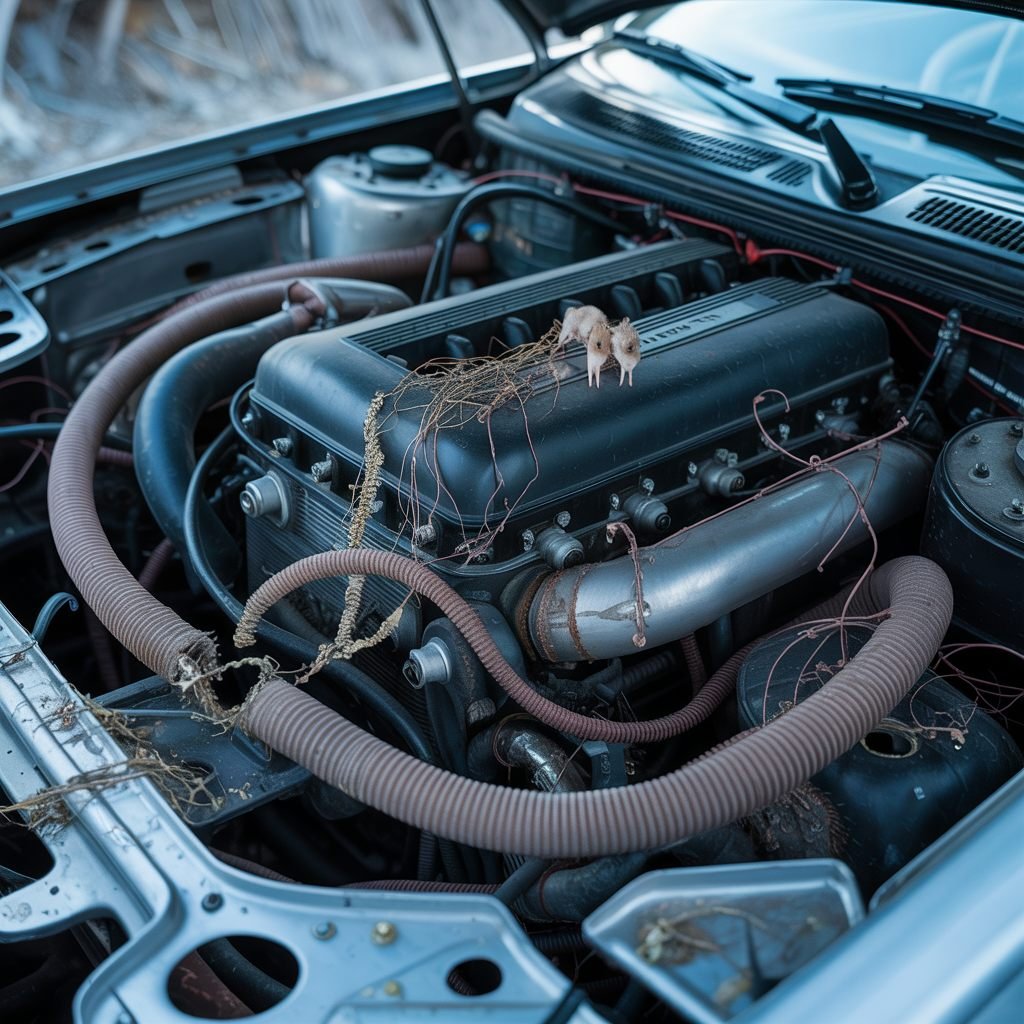
Tucson has a large population of RVs, travel trailers and boats that sit parked for months at a time. From a rodent's point of view a stored RV is close to ideal: enclosed, insulated, undisturbed, and full of fabric, foam and paper to nest with.
It is also, unlike a car, something you climb inside afterwards — which makes the contamination side of this more important than usual.
Where they get in
RVs have far more openings than a house of equivalent size, most of them underneath:
- Utility bays and pass-throughs where plumbing and wiring penetrate the floor. Factory sealing is usually foam and it fails.
- The undercarriage. Coroplast belly wrap tears and sags, and once torn the entire underfloor cavity is open.
- Slide-out seals. A retracted slide often leaves a gap at the corners.
- Furnace and water heater vents. Screened from the factory, but screens corrode and detach.
- Sewer and fresh water connections.
- Refrigerator vents on the exterior wall.
- The engine bay on motorhomes — same pack rat problem as any vehicle.
Why the damage is worse than in a car
An RV combines the wiring vulnerability of a vehicle with the soft furnishing of a house. Chewed 12V and 120V wiring, punctured water lines, damaged propane lines, destroyed upholstery and mattresses, shredded insulation, and contaminated soft surfaces you later sleep on.
Water line damage is the one that compounds. A chewed line that leaks unnoticed into a stored trailer causes floor rot and mould that costs far more than the rodent work.
Storing it properly
Before it sits
- Remove all food. Everything, including sealed packets, condiments and anything in a cupboard you forgot about. Also paper towel, tissues and napkins — nesting material.
- Clean thoroughly, including crumbs under cushions and in slide mechanisms.
- Empty and dry the water system.
- Open interior cabinets and drawers. Counterintuitive, but it removes the enclosed dark cavities that make good nest sites, and it lets you see evidence immediately on your return.
- Leave the fridge propped open and clean.
Sealing
- Pack copper mesh into every utility bay penetration and pass-through, then seal over it
- Repair torn belly wrap — tape is a temporary measure, patch panels are the fix
- Check and replace corroded vent screens
- Fit covers on sewer and water connections
- Inspect slide seals and replace perished sections
Where you park it
- On gravel or concrete rather than beside vegetation
- Away from woodpiles, stacked material and dense planting — the staging habitat that matters
- Away from block walls where middens establish
- With a light under or beside it if power is available
While it sits
- Check monthly. A five-minute look inside catches a problem while it is small.
- Move it occasionally if you can — a vehicle that never moves is a vehicle that gets settled into.
- Set traps inside during storage and check them on those monthly visits.
If you find a nest
Treat it as a contamination job rather than a cleaning job. Ventilate thoroughly before spending time inside. Wear a fitted respirator and gloves. Wet the material with disinfectant before removing it — do not sweep or vacuum dry. Bag and dispose of soft furnishings that have been nested in or urinated on rather than trying to clean them.
Then check the wiring, the water lines and the propane lines properly before the next trip. A propane line that has been gnawed is not something to discover on the road.
Not sure what you are dealing with?
A free inspection identifies the species, every entry point and the scope of work — in writing, before anyone quotes you a number.