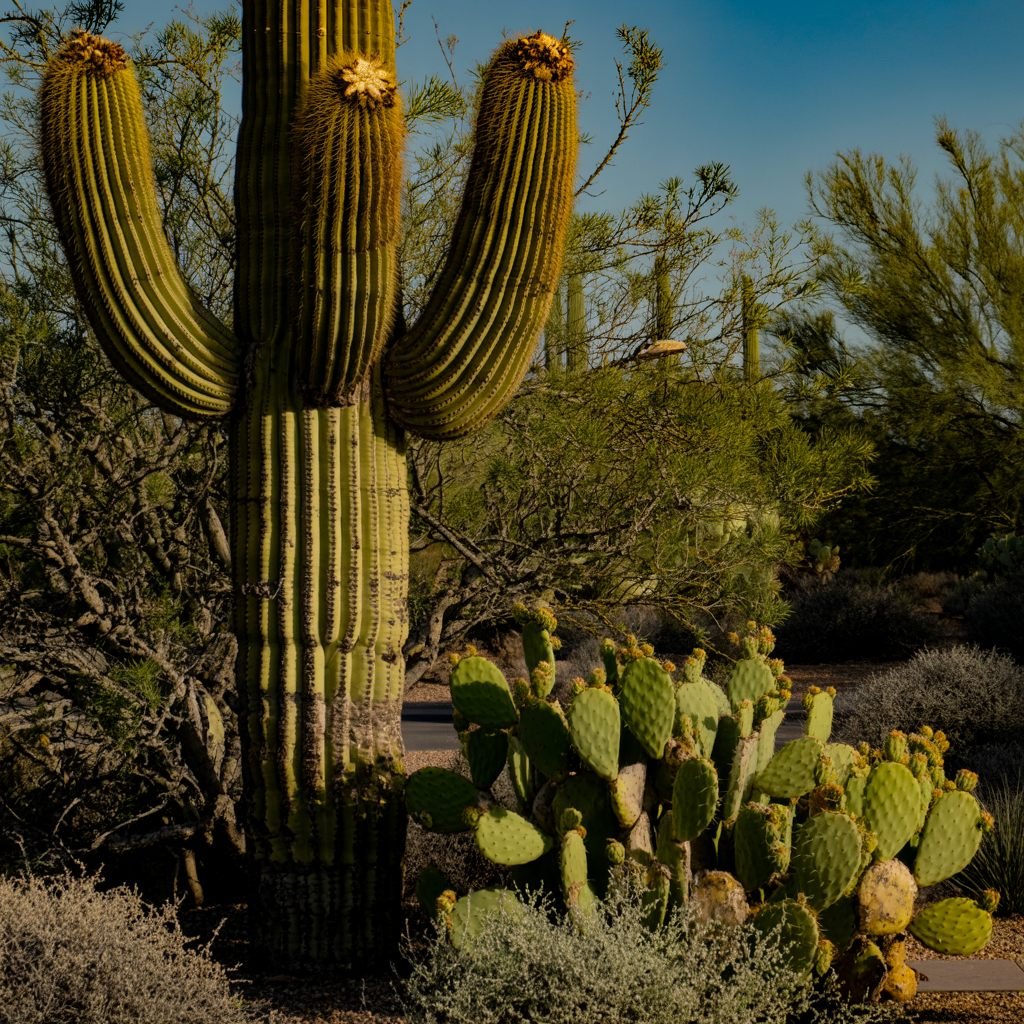
Every indoor rodent problem began as an outdoor one. The yard is where you get warning, often months in advance, and it is where the cheapest interventions live.
This is also the only place you will find pack rat middens, which are the single most important thing to locate on a Tucson property.
1. Middens
A pack rat midden is a large, untidy accumulation of sticks, cactus pads, leaf litter and collected debris — frequently with foil, wire ties or bottle caps worked in. There is usually a visible entrance hole.
Check these locations specifically:
- Along the base of block walls, particularly the shaded side
- Inside and beneath woodpiles
- Under decks, sheds, stairs and AC condenser units
- In the base of prickly pear and cholla, where spines protect the nest
- Beneath vehicles, trailers and equipment left unmoved
- Inside stacked pots, building materials and stored clutter
Do not disturb one. Middens are a documented kissing bug breeding habitat, white-throated woodrats carry arenaviruses transmissible through disturbed nesting material, and rattlesnakes, scorpions and black widows routinely shelter in them. See midden removal safety.
2. Runways
Rodents use the same routes repeatedly and wear visible paths — narrow tracks through groundcover, worn lines along the base of walls, or flattened channels through gravel and leaf litter. Runways almost always connect a shelter to a food or water source, so following one in both directions tells you a lot.
3. Burrows
Openings roughly two to three inches across at the base of walls, under slabs, beside irrigation boxes or in landscape beds. Active burrows have clean, smooth-edged openings with no cobwebs and often fresh soil fanned outside.
Smaller neat holes with mounded soil in open ground are more likely kangaroo rats, which are native and rarely a structural problem.
4. Gnawed cactus and vegetation
Pack rats chew prickly pear pads for water and food, leaving distinctive ragged damage at the base of the plant. Chewed irrigation tubing is another common find — the tubing is soft, and it also happens to deliver water.
5. Fruit damage
A hollowed-out grapefruit or orange still hanging on the branch, rind intact and inside eaten away, is a roof rat signature. Ground fruit that has been gnawed points to pack rats or mice. See citrus trees and rodents.
6. Droppings outdoors
Concentrated near a midden entrance, along wall bases and on top of block walls, which pack rats use as travel routes. Consult the droppings identification guide to confirm which species.
The three things drawing them in
Water
The desert's limiting resource, and the strongest single attractant. Walk your drip system while it runs and look for leaks, blown emitters and pooling. Fix hose bib drips. Check the AC condensate line, which produces a steady, reliable summer drip that rodents find quickly. Empty pet bowls overnight.
Note the exception: kangaroo rats do not drink free water at all, so removing water will not move them.
Food
Fallen citrus, mesquite and palo verde pods, spilled birdseed, pet food left outdoors, and unsecured bins. Weekly fruit pickup during the season does more than most products you can buy.
Cover
Rodents avoid open ground because of owls, hawks, coyotes and bobcats. Continuous dense planting lets them cross a property without exposure. Woodpiles, stacked material, palm frond skirts, dense oleander and unmanaged bougainvillea are all cover. See desert landscaping that does not attract rodents.
The yard-level fixes that matter
- Four feet of clearance between any branch and the roof, walls or another connecting tree — check the whole chain, not one obvious tree
- Woodpiles raised 18 inches off the ground and moved well away from the house
- A clear strip of 18–24 inches of open gravel against the foundation, which exposes anything crossing and makes inspection far easier
- Palm skirts removed — old frond accumulations are close to purpose-built rodent habitat
- Clutter cleared — stacked pots, materials, unused equipment
- Gravel rather than organic mulch near the house, which holds moisture and can be nested in
Why the yard decides the outcome
You can seal a house perfectly and still face continuous pressure if the yard supports a large population thirty feet away. Exclusion stops entry; habitat modification reduces how hard the animals are trying.
How to walk your own yard
Twenty minutes, once a quarter, and it catches most problems while they are still cheap.
- Walk the full perimeter of the house with your eyes on the wall base. You are looking for debris accumulating, droppings, rub marks and burrow openings.
- Walk every boundary wall, particularly shaded sides. Middens favour shade.
- Look under everything that has not moved recently — vehicles, trailers, equipment, stacked materials, the AC condenser.
- Look up. Check every tree for branches within about four feet of the roof, walls or another connecting tree. Check the whole chain, not one obvious tree.
- Run the irrigation and walk the drip lines looking for leaks, blown emitters and pooling.
- Check the citrus for hollowed fruit still hanging, and pick up what has fallen.
Photograph anything you are unsure about rather than poking at it — particularly debris piles, which should not be disturbed.
Seasonal timing for the yard
Spring is when to do the clearing work, ahead of the pressure. After each monsoon cell, walk the perimeter once the ground dries, looking for fresh debris accumulations from displaced animals. Autumn is peak activity, so evidence found then needs acting on rather than noting. Winter is citrus season, which makes fallen-fruit discipline matter more than at any other time of year.
Doing both is why our prevention work includes a written property-level plan rather than just a list of sealed holes. Book a free inspection and the walkthrough covers the yard, the structure, and any vehicles or outbuildings.
Want it confirmed properly?
A free inspection identifies the species, every entry point and the scope of work — with photographs, in writing, before anyone quotes a figure.
Explore this section
Signs of Rodents
Most homeowners call at week three. The ones who call at week one pay less and lose less insulation. Here is w…
In the Attic
The attic is where the expensive damage happens — insulation, ductwork and wiring. Here is how to inspect it s…

In the Car Engine
Tucson auto shops treat chewed engine wiring as routine, not rare. You do not need a rodent problem in the hou…

Droppings ID
Droppings tell you the species, roughly how many, where they travel and whether the problem is active. Here is…