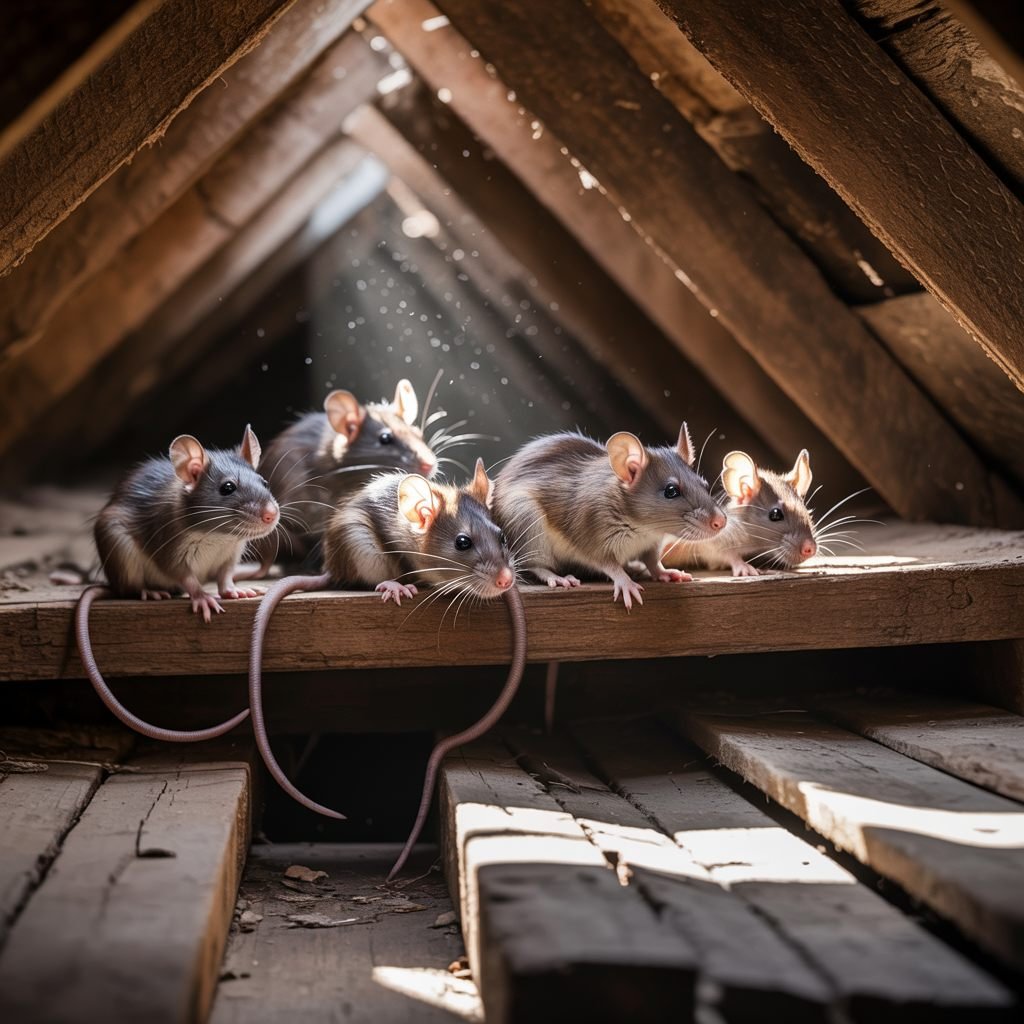
Casas Adobes is an established part of northwest Tucson — a mix of 1960s and 70s homes and newer infill, generally on generous lots with mature landscaping. That maturity is the whole rodent story here. Where a new subdivision has five-year-old shrubs, Casas Adobes has forty-year-old citrus, mesquite, palm and shade trees, and a lot of them reach the roof.
That single fact shifts the dominant species. This is roof rat country.
Why mature canopy changes everything
Roof rats are climbers. A branch touching or overhanging a roofline is a bridge that lets a rat reach the roof — and therefore the open tile terminations, the gable vents and the roofline gaps — without ever crossing the ground where a trap or a cat might catch it. A property can be immaculate at ground level and still have a serious roof rat problem, entirely because of the trees.
Citrus is a double factor
Established Casas Adobes lots often have producing citrus. Fallen and hanging fruit is a concentrated food source that sustains a larger roof rat population than the landscape otherwise would, and the canopy provides the route to the roof. Fruit on the ground overnight is one of the strongest attractants on any Tucson property.
The Cañada del Oro wash
The CDO wash runs along the northwest and acts as a wildlife corridor. Properties near it get pack rat pressure in the yard and vehicles on top of the roof rat pressure from the canopy — the classic overlap that produces "we treated it and it came back," because two species were present and only one was addressed.
What we usually find
- Roof rats in the attic, entering at tile terminations, gable vents and roofline gaps reached via tree canopy
- Chewed duct insulation in the attic — often first noticed as a room that will not cool
- Pack rat middens in yards near the wash, under condensers and in stored equipment
- Citrus-fed populations larger than the property would otherwise support
- Older-home vulnerabilities — worn roof penetrations, gaps at additions and remodels
Canopy clearance is half the treatment
You cannot durably solve a roof rat problem in Casas Adobes by sealing alone if the trees still bridge the roof. The two go together: seal the roofline entry points, and cut the canopy back so nothing overhangs or touches within the jump distance roof rats use. A common recommendation is a clear gap of several feet between any branch and the roof.
Homeowners are sometimes reluctant to cut back a beloved mature tree, and that is understandable — but a modest clearance prune is far less drastic than living with recurring attic rats, and it makes the sealing hold. We will show you exactly which limbs matter rather than over-pruning.
The older-and-newer mix
Because 85704 blends original mid-century homes with newer builds and heavy remodelling, the envelope quality varies house to house. Additions and remodels are frequent weak points — the junction between original structure and new work is where gaps open. Our inspection walks the whole roofline and every addition seam rather than assuming a uniform build.
No interior poison, and why it matters here
Mature neighbourhoods like this support owls, hawks and a healthy population of pets. Anticoagulant rodenticide moves up the food chain and kills the raptors that would otherwise hunt your roof rats for free, and it is a direct risk to dogs and cats. We trap and exclude instead — clearing the animals inside and closing the route in — without introducing poison to a property full of wildlife and pets.
What it costs
Roof rat jobs with attic entry and canopy work sit in the middle-to-upper part of our range because the roofline sealing takes time and the attic may need clean-up. Where citrus and the wash have produced a two-species problem, the plan covers both. See pricing and our services.
The "room that won't cool" clue
One of the most reliable early signs of roof rats in a Casas Adobes attic has nothing to do with noise. It is a single room that stops cooling properly. Roof rats chew the foil-and-fibre wrap on flexible AC ducts to get at the fibreglass for nesting, and a chewed or disconnected duct dumps cooled air into the attic instead of the room. Homeowners often call an HVAC company first, pay for a diagnosis, and only then learn the real problem is in the attic. If a room has quietly gone warm and you are in a canopy-heavy neighbourhood, check for rats before you assume the AC has failed.
Common questions from Casas Adobes homeowners
Do I really have to cut my trees?
Not remove them — clear them. A few feet of gap between the nearest branch and the roof removes the bridge roof rats use. We show you the specific limbs that matter rather than over-pruning a mature tree you value.
We treated last year and they came back — why?
Usually because the canopy still bridged the roof, or because a second species (pack rats from the wash) was never addressed. Durable results need sealing plus clearance, and a plan that covers every species present.
Is the citrus really the problem?
It is a major factor. Fallen fruit is concentrated food that supports a larger population. Picking up windfall fruit daily meaningfully reduces pressure.
Hearing activity overhead or noticing a room that will not cool? That is the classic Casas Adobes roof rat signature. Book a free inspection.
Want it confirmed properly?
A free inspection identifies the species, every entry point and the scope of work — with photographs, in writing, before anyone quotes a figure.
Explore this section
Tucson Areas
Rodent pressure is not evenly distributed across Tucson. Housing stock, elevation, vegetation and proximity to…
Catalina Foothills
Large lots, desert washes and mature tile roofs. The Foothills get both species at once, which is why partial …

Tanque Verde
Wash corridors, acreage and outbuildings. Tanque Verde properties have more structures than the average lot, a…
Oro Valley
Newer construction against open desert. Oro Valley homes are usually well built and still get pack rats, becau…
Vail
Open desert on every side, acreage lots and a lot of stored equipment. Vail is pack rat country, and the vehic…
Sam Hughes
Mature citrus, historic construction and a canopy that connects half the neighbourhood. Sam Hughes is roof rat…