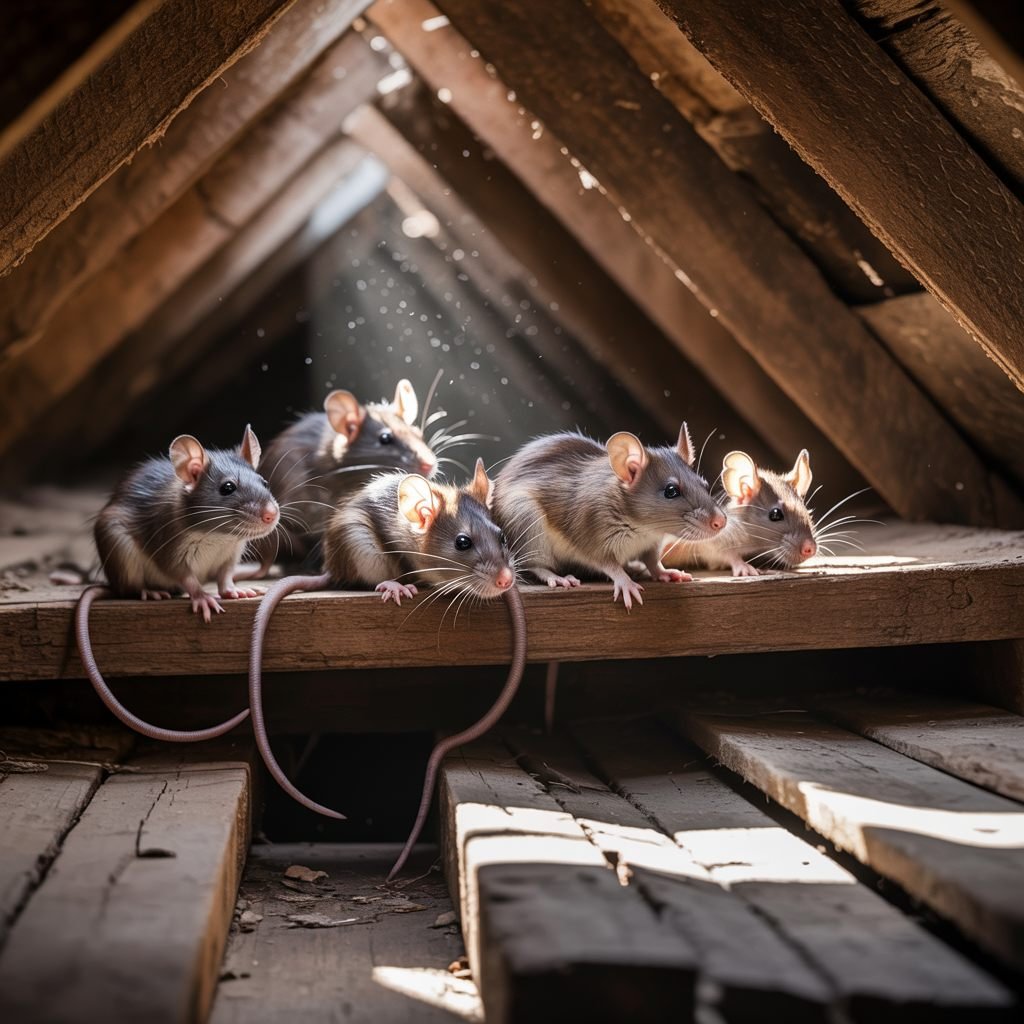
Trapping clears the animals that are already inside. It is a necessary part of the job and it is not the solution on its own — that is exclusion. We are explicit about this because the difference is what separates a job that finishes from one that runs indefinitely.
Why most trapping fails
Homeowners rarely fail because they bought the wrong traps. They fail on four things.
Density
Two traps for an active attic is not an attempt. Professional practice is a dozen or more, set in pairs along identified runs. Rodents breed fast enough that a slow removal rate never catches up, and a sparse set selects for trap-shy individuals — exactly the animals you least want breeding.
Placement
Rodents follow edges — walls, beams, pipe runs, duct lines — because contact on one side is safer than open ground. Traps in the middle of a floor catch very little. Set flush against the wall, perpendicular to it, trigger end toward the wall, where the droppings and rub marks actually are.
Species mismatch
Mouse traps do not reliably kill rats — they injure them, producing a suffering animal and a trap-wary survivor. Rat traps under-trigger for mice. Pack rats are different again: large, strong, native, and the midden is the real target rather than the trap line.
Neophobia
Rats are genuinely wary of new objects in a familiar environment and may avoid a trap for days. Pre-baiting — traps set unset and baited for two or three nights, then all armed on the same night — raises take rates substantially. Almost nobody does this at home.
Our article on why snap traps stop working covers all seven common mistakes.
How we do it
- Map the routes first. Droppings, rub marks and insulation trails tell us where the animals actually travel. Traps go there, not where it is convenient to reach.
- Match the trap to the species confirmed on inspection.
- Set at proper density — enough to outpace the reproduction rate, in pairs along runs.
- Pre-bait where the species warrants it, particularly for established rat populations.
- Check daily. Non-negotiable in Tucson — a carcass in a hot attic becomes an odour problem within a day or two, and the odour phase lasts weeks.
- Adjust. Three nights with nothing at a location means the placement is wrong. We move it rather than wait longer.
- Confirm clearance before the structure is fully sealed, so nothing is closed in.
Bait
Cheese is a cartoon. Rodents prefer high-fat, high-protein foods — peanut butter is the reliable default, and cotton wool or similar nesting material works well during breeding season. A small amount, so the animal cannot feed from the edge without applying force to the trigger. Traps are handled with gloves; heavy human scent on a new trap depresses takes in the first nights.
What we will not use
Glue boards
Inhumane, largely ineffective against rats, and in southern Arizona they routinely catch lizards, snakes and birds. We do not use them and we would encourage you not to either.
Interior poison
The failure mode is specific and predictable: the animal dies somewhere you cannot reach — a wall void, a duct run, above a ceiling — and you have traded a noise problem for a smell problem lasting weeks, sometimes requiring drywall to be opened.
There is also secondary poisoning. Anticoagulant rodenticides move up the food chain, and Tucson has owls, hawks, bobcats and coyotes, plus pets. Exterior bait stations have a legitimate role in some commercial settings and we will discuss it there; inside a home we consider it the wrong tool.
Dead animal recovery
If something has already died in a wall or duct — commonly after DIY poison use — we locate and remove it where access allows, and treat the area afterwards. Odour without a located carcass is usually a matter of narrowing down the location by smell intensity and, where necessary, making a controlled access opening.
Timeframe
A single mouse is often resolved in days. An established attic rat population typically runs one to three weeks of active trapping with daily checks, depending on numbers. Pack rats depend more on midden removal than on trap time.
Anyone promising same-day resolution on an established population is describing a visit, not an outcome.
What happens afterwards
Removal without sealing is a subscription. Once the population is clear we complete exclusion, then decontamination where contamination warrants it, and you get a written prevention plan.
Where we place traps, and why not elsewhere
Placement is decided by evidence rather than convenience, and it is worth explaining because it looks arbitrary otherwise.
In an attic, traps go along the eave line, across joist tops beside insulation trails, and adjacent to duct runs — because that is where the droppings and rub marks are. In a kitchen, they go inside cabinets, behind the fridge and along the kickboard, not out on the floor. In a garage, along the wall behind stored items rather than in the open.
We do not place traps where children or pets can reach them, and we will show you every location before we leave so nobody is surprised by one.
Why daily checks matter here specifically
In a cooler climate, checking traps every few days is acceptable. In Tucson it is not.
An attic in summer can exceed 140°F. A carcass in that environment begins producing odour within a day, and once it has permeated insulation and drywall the smell can persist for weeks regardless of what you do afterwards. Daily checking is not diligence for its own sake — it is what prevents a solved problem from becoming a different, worse problem.
It also gives us feedback. Three nights with no take at a given location means the placement is wrong, and we move it rather than leaving it and hoping.
Common questions
Do you use poison to remove rodents?
No. We trap so the animals can be removed rather than left to die in a wall — which in a Tucson summer becomes an odour problem within a day. Trapping also protects pets and the raptors that would otherwise be poisoned by eating a poisoned rat.
How long does trapping take?
Trapping usually clears the resident animals within a week or two, checked at least daily. The sealing done alongside it is what keeps the property clear afterwards — removal without exclusion just resets the clock.
What do you do with the animals?
Removed humanely and disposed of properly. Where a situation genuinely suits live capture and release, we will say so — but for most structural infestations, trapping is the humane and effective route.
Start with a free inspection — species, entry points and population scale confirmed in one visit, with photographs.
Want it confirmed properly?
A free inspection identifies the species, every entry point and the scope of work — with photographs, in writing, before anyone quotes a figure.
Explore this section

Services
Six services, one principle: seal the building first, then clear what is inside. Everything we do is built aro…

Rodent Exclusion
The only service on this site that actually ends the problem rather than managing it. Everything else is clean…
Humane Control
An honest page. Humane methods work well for some species and situations and poorly for others, and we would r…

Commercial
Same core process, scaled up — with the documentation a health inspector will actually ask for and a service s…

Prevention
The cheapest rodent work you will ever buy, because you are paying for sealing alone — not sealing plus remova…
Attic Cleanup
The work that should not be done unprotected. Contaminated insulation cannot be cleaned — it has to come out, …