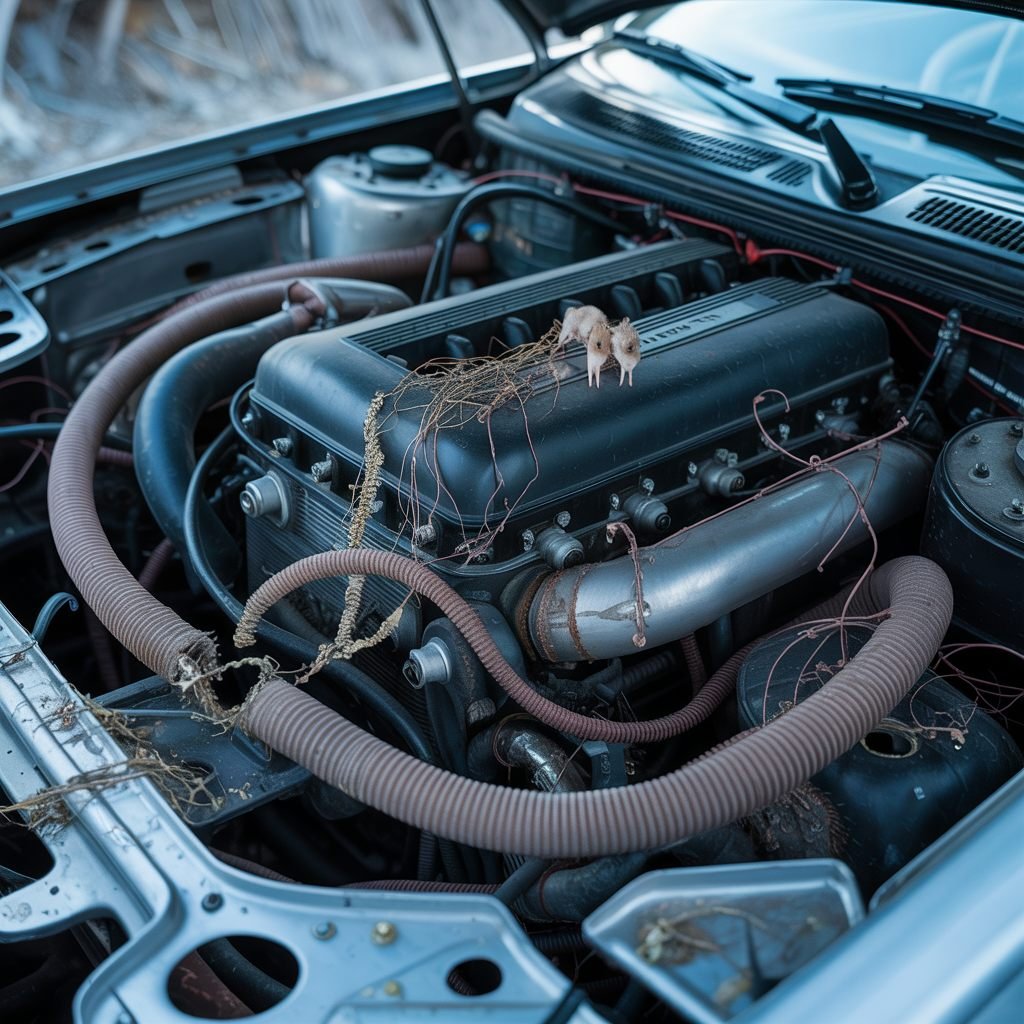
Of every call we take, this is the one that surprises people most. You do not have a rodent problem in your house. Your attic is silent. And then you pop the hood and find a pile of twigs, palm fibre and shredded insulation sitting on top of the engine block.
Tucson auto shops treat this as a routine repair category. Not unusual, not seasonal — routine.
Why the engine bay specifically
Pack rats (Neotoma species, also called woodrats) are nocturnal and are looking for three things at once: warmth, darkness, and enclosure on most sides. An engine bay an hour after you park delivers all three better than almost anything else on your property.
Then there is the building material. Rodents do not haul nesting material far when they do not have to, and your own landscaping supplies it — palm fibre, oleander leaves, mesquite twigs, bougainvillea litter. A pack rat can build a functional nest on your intake manifold using material sourced from within about twenty feet of the car.
The damage comes from the gnawing, and the gnawing is not optional. Every rodent has a single pair of continuously growing incisors that must be worn down constantly. Wiring looms, vacuum hoses and sound-deadening foam are all the right hardness. It is not spite and it is not random — it is dental maintenance happening in the worst possible place.
What it costs
Repairs range from trivial to genuinely painful. A single chewed sensor wire might be a modest fix. A harness that has been worked over across several nights can run well past a thousand dollars, because the labour to trace and replace loom sections is significant even when the parts are cheap.
Two things make it worse in Tucson specifically. First, vehicles that sit — second cars, work trucks, RVs, anything parked more than a few days — give a nest time to establish. Second, carports. A carport is warm, shaded, sheltered and usually adjacent to exactly the kind of yard clutter pack rats stage from.
Four things that actually work
1. Park inside a closed garage
If this is available to you, it ends the problem. Everything below is for when it is not.
2. Leave a light on the engine overnight
A mechanic's drop light under the hood or on the ground beneath the engine is genuinely effective. Pack rats avoid lit open space because light exposes them to owls, coyotes and bobcats. This is the cheapest intervention available and it works better than most products sold for the purpose.
3. Clean the bay after any nest — properly
This is the step people skip and it is the reason the problem repeats. Rodents navigate and communicate by scent. A bay that had a nest in it still smells like a viable nest site to the next pack rat, even after you have removed every twig. Removing the nest without neutralising the scent trail is why homeowners tell us they cleared it twice in one month.
4. Fix the yard, not the car
The car is the symptom. The source is the staging habitat next to it: woodpiles, stacked pots, cactus debris, dense oleander, an unmaintained pile of anything within about thirty feet of where you park. Pack rats build a midden first and forage out from it. Remove the midden site and the vehicle stops being convenient.
What does not work
Peppermint oil, dryer sheets and mothballs are all popular and all unreliable. They may deter a rodent for a few nights while the scent is strong, which is exactly long enough for you to conclude they worked. Ultrasonic devices perform poorly in an engine bay, where metal surfaces block and reflect the signal.
Poison is a bad idea near a vehicle for a separate reason: a rodent that dies inside your dashboard or ventilation ducting creates a problem that is considerably worse and harder to reach than the one you started with.
When to call someone
If you have found a nest more than once, the issue is not the car — it is an established midden on the property that you have not located yet. That is worth an inspection, because middens are usually tucked against block walls, under decking or inside dense plantings where they are easy to walk past for years.
Not sure what you are dealing with?
A free inspection identifies the species, every entry point and the scope of work — in writing, before anyone quotes you a number.